Showing posts with label dentist. Show all posts

Tuesday, 12 June 2018

Infant tongue ties – should I have my baby’s tongue cut?

Tongue-tie, or ankyloglossia, is a condition whereby the lingual frenulum (stringy bit under your tongue) attaches near the tip of the tongue and may be short, tight and thick. It is potentially a concern if it limits the range of movement of the tongue, interfering with feeding or speech. Tongue-tie is present in ~4% to 11% of newborns and has been cited as a cause of poor breastfeeding and maternal nipple pain. Frenotomy (cutting/removal of the tongue tie) has been promoted to correct restriction of tongue movement and allow more effective breastfeeding with less maternal nipple pain. Recently there have been dramatic increases worldwide in performing this procedure. Canada has reported an 89% increase, the USA a 300% increase between 2006 – 2012 and in Australia a 420% increase has been reported. Frenotomy may seem like a logical solution but is it supported by evidence?

A Cochrane review based on older research found frenotomy reduced breastfeeding mothers' nipple pain in the short term but did not find a consistent positive effect on infant breastfeeding. However the evidence was based upon only a small number of studies with a small number of infants. More recent research in Australia has found an alarming increase in the number of frenotomies or tongue-tie releases being performed and in New Zealand it was found to be performed in 13% of newborn infants. With only 25-50% of babies with ankyloglossia having feeding problems, the target or suggested rate for tongue-tie release surgery is between 0.2-5%. This suggests many of these procedures are being performed without indication and potentially placing the child needlessly at risk of complications.

A recent study in Western Australia found instead of improving breastfeeding rates, the frenotomy was actually more likely to lead to early weaning! Their research revealed that the real problem in many cases was low milk production and not the baby’s tongue tie. Breastfeeding rates were NOT improving following surgery and some babies required hospitalisation for serious bleeding or infection. It therefore appears many may needlessly be receiving this procedure and being placed at harm. Frenotomy may seem like a ‘simple’ solution and for some it is appropriate but if you are unsure, then seek a second opinion from your Paediatrician.

Dr Peter Miles is the orthodontist at Newwave Orthodontics in Caloundra, Australia and has taught orthodontics part-time at the University of Queensland and Seton Hill University in the USA for over 10 years. Peter is one of the editors and authors of the orthodontic textbook, 'Evidence-Based Clinical Orthodontics'. Importantly, he has no financial interest in any products or techniques mentioned in these Blogs.

Tuesday, 5 September 2017

Digitally positioned brackets - are they any better?

In orthodontics, the current trend is to find ways to accelerate treatment with many appliances making these claims, even in the naming of their appliance or technique (Fast, Quick, Rapid, Speed, 6-month, etc.). There is substantial evidence now to demonstrate that simply changing to a different type of bracket makes no difference – it is the skill of the operator that is most important, otherwise the patient may be accepting a compromise. For example; if treating only in round wires then the roots are not rotated, tipped or especially torqued into their best and most stable positions or the occlusion or overjet not addressed.

To overcome this, some companies have suggested that digitally positioned brackets are the answer as they reduce variability and take into account a lot of the skill and variation of the operator. Systems such as Insignia, SureSmile and even Invisalign are examples of these in orthodontics. However, there is a lot of biological variation with individual patients varying in response as well as appliances do not deliver 100% of what is built into them which is why detailing/finishing is required (the fiddly part of orthodontics). Previous retrospective studies have suggested that digitally customised appliances did deliver faster treatment but these had the same flaws as the self-ligating bracket and vibration appliance studies in that there is a high risk of bias and potential confounding variables that can influence the result beyond just the appliance (the later RCTs found no difference). This is why blinded, RCT’s are considered the gold standard – but also take more time and cost to conduct. However, an RCT was just published online in the Journal of Dental Research (considered the top journal in dentistry in terms of the quality of the articles) and this paper looked at the Insignia system of digitally positioned brackets compared with conventional placement. The results were interesting!

There were 180 patients in this RCT and when completed, they analysed 85 patients in the customized group and 89 in the non-customized group. The authors found no difference in treatment duration (digital = 1.3 years vs. conventional = 1.2 years) or quality of outcome as measured by the PAR (Peer Assessment Rating) index. Most importantly, the Orthodontist did have a significant effect on treatment duration, quality of treatment outcome, and number of visits (P < 0.05) - not the appliance used. Interestingly, the customized orthodontic group also had more loose brackets, a longer planning time, and more complaints (P < 0.05).


In the rush (pardon the pun) for faster treatment and to seem to be on the cutting edge, we can leap into new technologies. Sometimes they deliver what they claim while at other times they do not. Such systems usually involve additional cost with an expectation by the patient of faster treatment but in this case, it wasn’t delivering what it claimed. Some practitioners may prefer these systems and that is a personal choice just as some prefer one bracket type over another, but when claims are made of a faster or better outcome (and often at added cost)… proof rather than opinion is required. As Carl Sagan (Astrophysicist) famously stated; ‘Extraordinary claims require extraordinary evidence’.

Sunday, 4 September 2016

ALLERGIES, HABITS AND MALOCCLUSION IN YOUNG CHILDREN - WHAT HAPPENS OVER TIME?

Some clinicians advocate very early treatment in the primary (~ages 3-5) dentition and recommend interventions claiming they will prevent future orthodontic problems. But what if we did nothing and observed them? This very interesting article from Sweden followed 277 children from age 3 to age 11.5 and evaluated the presence of malocclusion, sucking habits, breathing problems, allergies and trauma over time.

There was quite a high prevalence of malocclusion at age 3 of 71% and although this improved by age 7 to 56%, it worsened again to 71% by age 11.5. However ~45% of subjects were considered in severe or moderate 'need' of treatment so ~55% had minor or no need. Many advocates of early treatment suggest intervention for open bites but interestingly this was one of the malocclusions that tended to self-correct as found by previous authors. Conversely deep bites did tend to worsen. As with previous studies trauma to the top front teeth was ~2.2 times more likely with increased protrusion/overjet.

Another re-emerging (previously in 1930's then 1960-70's) claim in orthodontics is the influence of habits and allergies on malocclusion and that early intervention is required to prevent adverse growth effects. This long-term observational study found sucking habits had little or no association with anterior open bite or posterior crossbite in the permanent dentition. As I have discussed in a previous Blog, many children stop the habits themselves as they get older and an open bite can improve spontaneously so treatment may not be indicated except in those that persist longer term.

Similarly allergies at age 3 had NO association with any future malocclusion at age 11.5. There are many good reasons for allergy, tonsil and adenoid treatments but to prevent abnormal facial growth is not one of them. I have personally had an ENT tell my wife that our 9 y.o. daughter (who suffers from allergies) required a turbinectomy otherwise she will undergo abnormal jaw growth - you can probably guess my response to that! My daughter has normal horizontal and vertical facial growth with mild crowding and although she will require some orthodontic treatment once all adult teeth have erupted for the mild crowding, her growth is proceeding just fine without the surgery. I feel sorry for those parents that do not have the knowledge of normal facial growth that I do as they may be 'scared' into having procedures for their children that they may otherwise think twice about. This article helps contribute to that knowledge so thanks to this Swedish team for following this group and presenting their findings.

Dr Peter Miles is the orthodontist at Newwave Orthodontics in Caloundra, Australia and teaches orthodontics part-time at the University of Queensland and is a visiting lecturer at Seton Hill University in the USA. Peter is one of the editors and authors of the orthodontic textbook, 'Evidence-Based Clinical Orthodontics'. Importantly, he has no financial interest in any products mentioned in these Blogs.

Wednesday, 8 June 2016

THE CVM METHOD AND THE IDEAL TIME FOR ORTHODONTIC TREATMENT.

The timing of treatment of Class II (protrusive top teeth &/or retruding lowers) patients has been debated for many years in orthodontics with some claiming you need to treat early, even as young as 5-8 (discussed in a previous Blog) or 9-10 or wait until 12-13! Several indicators have been used to assess the ideal timing and a more recent one is the Cervical Vertebral Maturation method (CVM) which uses the maturational stages of the cervical vertebrae in the neck on a cephalogram x-ray.

The CVM method was first developed by Don Lamparski along with Maria O'Reilly at the University of Pittsburgh where I trained and was later modified. However to be useful a method needs to be reliable and valid. One article demonstrated <50% intra-rater agreement (in other words less than half the time you agree with your own assessment). Another demonstrated that the CVM method offered no advantage over chronological age. Two recent papers concluded "CVM method could not accurately identify themandibular growth peak" or "...cannot predict craniofacial growth in girls with Class II malocclusion.". But let's say you do identify the ideal timing of treatment using the CVM method with the Herbst the study found ~1.9mm of advancement of Pogonion. However another study in adults (who are not growing) found they could still gain 1.3mm of advancement of Pogonion  so the ideal timing was only 0.6mm better and that is also assuming the change holds up long term which we know from other trials it doesn't.

The timing of orthodontic treatment is an interesting topic and really revolves around the issue of whether we can ‘modify growth’ of the mandible or not. Based upon the available quality scientific evidence it seems we can temporarily accelerate mandibular growth (Lysle Johnston’s ‘mortgage on growth’) but not achieve a significant long-term change and so the final outcome is mostly dento-alveolar/tooth movement. Studies supporting a change are retrospective in nature and/or use a historical control which is ~60 years old and not valid for comparison as trials using historical controls show larger treatment effects. In contrast the prospective RCT’s (UK, UNC, Florida) show no difference between treating early or in adolescence and this is supported by the Cochrane Review on the topic. The long-term ‘amount’ of change is similar regardless of the timing of treatment so it is more the ‘efficiency’ of the change/how quickly that is achieved that is affected by timing. Therefore the importance of determining the ideal timing of treatment with any method seems of minimal significance to the final outcome.

Finally I would like to thank Maria and all my other instructors at the Univ of Pittsburgh. I was so incredibly fortunate to have such wonderful mentors and friends.


Dr Peter Miles is the orthodontist at Newwave Orthodontics in Caloundra, Australia and was a part-time lecturer at the University of Queensland for 11 years and is a visiting lecturer at Seton Hill University in the USA. Peter is one of the editors and authors of the orthodontic textbook, 'Evidence-Based Clinical Orthodontics'.

Monday, 7 March 2016

PASSIVE SELF-LIGATING BRACKETS ARE BETTER - IT'S OBVIOUS?


PSL vs. ASL vs. Conventional bracketsThis Blog topic was prompted by comments in Kevin O'Brien's excellent Blog regarding 'thinking about orthodontics'. Kevin was discussing evidence-based care and what we know versus what we don't know and how to apply our knowledge, skill and experience as clinicians in the treatment of our patients. Many suggestions were made about what we do and don't know but two comments in particular claimed that Passive Self-ligating (PSL) brackets were superior to conventional brackets during initial alignment in non-extraction treatment. I have also seen other claims in Facebook study clubs where the clinician states that in their experience, PSL brackets are superior for space closure in extraction cases (a future Blog topic). So is this evidence or their opinion and what is the evidence if any?


In 2006 I conducted the first prospective study comparing PSL brackets with conventional brackets in the lower arch in non-extraction cases. This was published in The Angle Orthodontist and I found that the PSL bracket was no better during initial alignment than a conventional bracket. Another non-extraction study published in the American Journal of Orthodontics in 2010 found there was no difference between PSL or Active SL brackets. Based upon this evidence in clinical trials this refutes the claim that PSL brackets are more effective in non-extraction cases during initial alignment. If we then include the evidence from extraction cases as well, this was summarised very nicely in another article in the American Journal of Orthodontics in 2014 where the data was plotted graphically (shown below) in a meta-analysis. The vertical line at zero ('0') represents no difference between brackets and the purple squares are the individual studies. What we are most interested in are the large green diamonds which represent the results combined together and as they overlap the zero line, this indicates there was no difference between any of the bracket types tested across the various studies during initial alignment. It seems the evidence is quite compelling that there is no advantage in PSL or ASL brackets over conventional brackets during initial alignment.


As the evidence clearly shows there is no difference between brackets, the choice of bracket then comes down to the personal preference of the clinician. BTW if you are interested in evidence-based orthodontics then I highly recommend subscribing to Kevin's Blog at http://kevinobrienorthoblog.com/

Dr Peter Miles is the orthodontist at Newwave Orthodontics in Caloundra, Australia and was a part-time lecturer at the University of Queensland for 11 years and is a visiting lecturer at Seton Hill University in the USA. Peter is one of the editors and authors of the orthodontic textbook, 'Evidence-Based Clinical Orthodontics'.

Tuesday, 29 December 2015

HIGHEST VIEWED BLOGS SO FAR!!

For this Blog I thought I would recap the 5 most popular Blogs I have published so far and it is interesting to note that they are all related to early #orthodontic treatment. Although some of these involve the same topic I will rank them in order of the most viewed individual Blogs. Note the text in a different colour is a link to the original Blog or document so just click on it if you wish to know more.

1) The most read and searched Blog and also one of the more recent was 'Maxillary Expansion - Unexpected Benefits?' in September this year. This Blog has interest for readers who are clinicians as well as the general public discussing #expansion and its possible effect upon bed-wetting, sleep #apnea and middle ear problems. Expansion is a common procedure in orthodontics but there is limited quality research on these specific areas. It is also an emerging topic with a lot of mis-information accessible on search-engines and deserves more well-designed research in the future.

2) On a similarly related topic was this Blog back in January 2015 titled 'Do Orthodontic Extractions Cause Sleep Apnea?'. Again it is a controversial and emerging subject with a lot of mis-information which is easy to disseminate when there is minimal research. I am glad these two topics have received such an enthusiastic response.

3 - 5) The next three topics all related to #Myofunctional appliances. In order these Blogs were 'More on Myofunctionals - 2 Clinical Trials' followed by the first of the Blogs on this topic, 'Myofunctional Appliances - What's the Evidence?'. The third and most recent of the Blogs on this topic was also the most recent Blog prior to this and reported the 'Results of a RCT of a Prefabricated Functional Appliance'. This is an area dominated on search engines by companies and clinicians extolling the virtues of these appliances and treatment approach. The higher levels of evidence come from clinical trials which are discussed in these Blogs and although these trials are not ideal they currently are the best level of evidence we have and come to a similar conclusion. Although they find statistical differences, these differences were quite small and indicated that these appliances were less effective than more conventional treatments for bite correction. Despite being in an evidence-based era where we would like to see well-conducted clinical trials upon which to base our treatments, there is limited quality research and both clinicians and the general public need to be wary of the claims being made until well designed research is available.

I would like to thank you the reader for your interest as my goal throughout is to provide quality information for clinicians and the general public on the more controversial topics in orthodontics. I would also like to point out that I have no financial interest in any appliance or technique I discuss in these Blogs so when gathering information, consider whether the source of information is potentially biased and associated with that particular appliance or technique.

Remember any of the Blogs can be found at
 http://newwaveorthodontics.blogspot.com.au/ and scrolling down and older ones can be accessed at the bottom of the page by clicking 'older posts'. Wishing all a happy, safe & prosperous 2016.

Dr Peter Miles is the orthodontist at Newwave Orthodontics in Caloundra, Australia and teaches orthodontics part-time at the University of Queensland and is a visiting lecturer at Seton Hill University in the USA. Peter is one of the editors and authors of the orthodontic textbook, 'Evidence-Based Clinical Orthodontics'.

Monday, 19 October 2015

RESULTS OF A RCT OF A PREFABRICATED FUNCTIONAL APPLIANCE - MYOBRACE

One of the most popular topics in my series of Blogs has been on prefabricated #Myofunctional appliances and so I thought I would share the results of this randomized clinical trial from Sweden which was presented at the recent 8th International Orthodontic Congress in London. The complete abstract is below and follows on from their paper reported at the 7th IOC in Sydney in 2010 which I reported here.

The conclusions reinforce that the overjet/protrusion correction obtained with the prefabricated Myobrace was dental/tipping of teeth while the custom made #Activator appliance achieved a better molar correction, however compliance with both appliances was poor. This will affect the clinical choice of an appliance as in cases where simple tipping may be suitable then the cheaper prefabricated appliance may be appropriate. However if more molar bite correction is required then the custom-made appliance would be more suited.... as long as they wear it. The percentage of subjects in this study having unsuccessful treatment was very high at 70% with the Myobrace appliance and ~53% with the Activator which the authors attributed mainly to a lack of compliance. The patient and the family should therefore be involved in the appliance choice or alternatively appliances that do not require as much cooperation can be used (the subject of a future Blog). These authors are to be congratulated on a job well done in conducting this trial.

Update: The full paper is now available in the European Journal of Orthodontics.


Authors
E. Cirgic, K. Hansen, H. Kjellberg.

Abstract:
TREATMENT EFFICACY OF PREFABRICATED FUNCTIONAL APPLIANCES AND ANDRESEN ACTIVATORS IN CLASS II, DIVISION1 CASES: A RANDOMIZED CLINICAL TRIAL
Aim: The purpose of this study was to compare the clinical effectiveness in reducing large overjet between a prefabricated functional appliance (PFA) and a slightly modified Andresen activator (AA).
Methods: A multicentre, prospective and randomized clinical trial was conducted in 12 general dental practices and an ethical committee approved the study. The sample consisted of 97 subjects (44 girls, 53 boys) mean age 10.3 years with a Class II, division 1 malocclusion and an overjet ≥ 6 mm. The study was designed as intention to treat and the patients were randomly selected to treatment with either a PFA or a AA. The PFA and AA group consisted of 57 subjects (28 girls, 29 boys) and 40 subjects (16 girls, 24 boys) respectively. Overjet, overbite, lip seal and sagittal relation were recorded before and at 3, 6 and 12 months after start of treatment. The endpoint of treatment was set to overjet ≤ 3mm and after this a 6 months retention period followed.
Results: No significant difference was found in overjet, overbite and lip seal between the two groups. Significant difference was found in sagittal molar correction between the two groups. The treatment of 40 patients with PFA and 21 with AA were considered unsuccessful mainly due to poor compliance.
Conclusions: Prefabricated functional appliances are as effective as Andresen activators in correcting overjet, overbite and lip seal. Andresen activators seem to be more effective in sagittal molar correction than PFA. The success rate in treatment with both appliances is however, low.

Dr Peter Miles is the orthodontist at Newwave Orthodontics in Caloundra, Australia and teaches orthodontics part-time at the University of Queensland and is a visiting lecturer at Seton Hill University in the USA. Peter is one of the editors and authors of the orthodontic textbook, 'Evidence-Based Clinical Orthodontics'.

Tuesday, 1 September 2015

MAXILLARY EXPANSION - UNEXPECTED BENEFITS?

Maxillary expansion is a relatively common procedure in orthodontic treatment for bite correction and I have Blogged previously about it for the correction of crossbite as well as its use in creating space. However, expansion has also been showing some unexpected benefits for some patients in other areas which I will discuss in this Blog.

Expansion of the upper jaw is most effective in pre-pubertal children when the midline suture is still responsive and the surrounding bones are more malleable. As the maxilla (upper jaw) forms the floor of the nasal airway and supports the soft tissues of the nose, this expansion has been suggested to improve a constricted or congested airway. Much of this was anecdotal as improvements can occur coincidentally or with time and not necessarily be related to the procedure. This is why research in the form of clinical trials is important to try to reduce the biases inherent in simply observing something. However there is a growing body of evidence of the potential beneficial effects of maxillary expansion beyond the correction of dental crossbites.

Expansion and Nocturnal Enuresis/Bed-wetting:
In the 1990's some research suggested that expansion of the upper jaw may help reduce nocturnal enuresis or bed-wetting in children. More recent studies agreed with these findings showing significant reductions (~75%) in the number of nights of bed-wetting following expansion with ~30% were completely dry at night after expansion. This was even in the absence of a pre-existing crossbite. Suggested reasons for this improvement relate to an indirect effect on the pituitary gland or an improvement in the airway with expansion which may help with a possible association between enuresis and sleep disordered breathing in children.

Expansion, Congestion, Sleep Apnoea:
One of the above papers also found that nasal airflow increased while nasal resistance to airflow decreased. Earlier research by Peter Vig in the 1980's found that rapid maxillary expansion resulted in a significant reduction in nasal resistance but there was considerable variation and so the outcome was not predictable. Other research has shown this reduction remained a year later. Another paper found those with the highest initial nasal resistance tended to obtain the greatest benefit from expansion with the greatest reduction in nasal resistance.

Maxillary expansion has also been suggested to improve obstructive sleep apnoea or apnea in children (where the child stops breathing several times per hour of sleep). I have discussed extractions and sleep apnoea previously. Studies have found expansion can result in a significant reduction in the numbers of episodes of apnea in children including those with enlarged tonsils and adenoids. Although the response is unpredictable the results are promising enough to warrant more comprehensive clinical trials and to be considered as a treatment strategy especially when there are other reasons to consider maxillary expansion.

Expansion and the Middle Ear:
In studies on patients with narrow arches and conductive hearing loss it has been found that rapid and semi-rapid expansion of the maxilla resulted in an improvement in hearing and eustachian tube function and these improvements held up for 3/4 of the subjects up to 2 years later. However these are children with narrow jaws so the same may or may not hold for those with normal or wide arches.


Summary
So it seems that maxillary expansion may have benefits beyond correcting crossbites and creating some space. However it must be kept in mind these studies are not definitive and the outcomes are not guaranteed so more research in the form of randomised clinical trials is indicated. For this reason expansion may be suggested when it is indicated for other reasons or in consultation between your medical practitioner/sleep physician/Otolaryngologist (ENT) and your orthodontist.


I would like to thank Dr James Noble (Orthodontist - Toronto) for his feedback on this Blog topic.

Dr Peter Miles is the orthodontist at Newwave Orthodontics in Caloundra, Australia and teaches orthodontics part-time at the University of Queensland and is a visiting lecturer at Seton Hill University in the USA. Peter is one of the editors and authors of the orthodontic textbook, 'Evidence-Based Clinical Orthodontics'.

Wednesday, 1 July 2015

VIBRATION & ACCELERATED ORTHODONTICS - CLAIMS VERSUS EVIDENCE

Claims of faster treatment with 'special' quick or fast braces or appliances such as AcceleDent, OrthoPulse and others are appearing more and more in the market place and on Google. The companies hope their product can shorten treatment and heavily advertise so - but what is the evidence?

When you are paying up to $1000 or even more for something you want to be sure or pretty sure it works... or not care about the $1000! Some clinicians and patients use the special brace or appliance and feel their treatment went faster and extol the virtues of the appliance while others do not see a difference, shrug their shoulders and move on. When we are told something is better/faster we look for that difference - some remember the ones that worked (the Believers) while others remember the ones that didn't (the Naysayers) and so we now have two camps, both with a biased perspective! This happened with self-ligating brackets where initially it was felt by some that they shortened treatment (and appeared in the media saying so) but later research revealed that in fact they were not (see my previous Blog on Braces claiming to be Fast)!

Currently some state that you can use #Invisalign clear aligners every week instead of every two weeks (as the manufacturers currently recommend) when using #vibration or other appliances. However many patients get away with weekly wear without these appliances anyway while others won't. There are current studies that suggest vibration accelerates tooth movement with braces while a better designed prospective trial finds no difference. I am currently running a randomized clinical trial on the vibration appliance, AcceleDent and the results of this will be available for publication later this year (2015) to further examine any effect of vibration during initial alignment and space closure so this will be discussed in a future Blog. Although the idea of vibration holds some merit, the evidence supporting it is currently of a lower quality while the higher level evidence from a prospective randomized trial finds no difference. More research is obviously required to clarify the debate and will be forthcoming over the next couple of years but it is the quality of the evidence that is important to answering this question.

Dr Peter Miles is the orthodontist at Newwave Orthodontics in Caloundra, Australia and teaches orthodontics part-time at the University of Queensland and is a visiting lecturer at Seton Hill University in the USA. Peter is one of the editors and authors of the orthodontic textbook, 'Evidence-Based Clinical Orthodontics'. Importantly, he has no financial interest in any products discussed in these Blogs.

Monday, 20 April 2015

MORE ON MYOFUNCTIONALS - 2 CLINICAL TRIALS

Some manufacturers of myofunctional appliances claim that that they achieve better results by treating at a very young age (~5-8 years of age) but what is the evidence? I have Blogged on this topic previously but more recently I came across two unpublished randomised clinical trials (RCT's - which are considered the more robust way of testing a treatment) where they compared myofunctional appliances with conventional functional appliances - so what did they find?

The first was presented at the European Orthodontic Congress in Istanbul- Turkey (Abstract book, scientific poster :361) and was a follow-on from their previous study evaluating comfort of myofunctional appliances where they found the Activator caused less discomfort and was more acceptable than the T4K™ myofunctional appliance  (Eur J Paediatr Dent. 2012;13:219-24). The follow up study evaluated the effectiveness of the appliances and the abstract (found here) presented the results of the 60 patients treated over the 14 months of the study. The authors found that the Activator group showed better skeletal improvement than the myofunctional T4K® group. They also found that the facial convexity improved significantly with the Activator and to a lesser extent with the T4K® while the soft tissue profile was improved only by the Activator. They concluded that the Activator is more effective than the T4K® in treating patients with protrusive upper teeth (Class II division 1).

The second paper was presented at the World Federation of Orthodontists meeting in Sydney (abstract #0335 of this PDF file) and was a multi-centre RCT of 74 subjects comparing another myofunctional appliance with an Activator. Although they found that the prefabricated myofunctional appliances were as effective as Activators in correcting overjet/protrusion, they were less effective in correction of the Class II molar relationship (bite on the back teeth). This implies that the main factor in correction of the overjet/protrusion was only due to tipping of the front teeth as discussed in the previous Blog on myofunctionals (study by Usumez. Angle Orthod 2004;74:605-60). However the advantage with the myofunctional appliance is that no impressions are needed and the cost is less than that of the Activator.

So it would seem that myofunctional appliances have 'some' effect but were less effective than the custom made Activator appliance, particularly in molar/bite correction and skeletal/growth change. This is consistent with the findings of studies discussed in my previous Blog on Myofunctional appliances.


If we are then considering what is the most effective appliance then the custom-made appliances win out but a case could be made where in remote communities with limited or no access to laboratories for impressions or making a custom-made appliance, then perhaps a prefabricated myofunctional appliance can offer some improvement. Both of the main authors of these RCT's are currently PhD candidates and therefore extremely busy people but I also believe they are in the process of writing these papers up for publication which will allow a more thorough read of the trial design and findings.

Dr Peter Miles is the orthodontist at Newwave Orthodontics in Caloundra, Australia and teaches orthodontics part-time at the University of Queensland and is a visiting lecturer at Seton Hill University in the USA. Peter is one of the editors and authors of the orthodontic textbook, 'Evidence-Based Clinical Orthodontics'. Importantly, he has no financial interest in any products discussed in these Blogs.

Thursday, 12 March 2015

WHAT AGE IS BEST FOR ORTHODONTIC TREATMENT TO ACHIEVE THE BEST JAW GROWTH?

myofunctional appliancesMany orthodontic associations around the world recommend an orthodontic exam at age 7 but does this mean your child needs treatment then? There is much debate over what is the best time to treat protrusive upper teeth and/or a retrusive lower jaw (Class II bite like Bart). Some suggest waiting until adolescence (when all adult teeth have erupted), others earlier at age 9-10 with functional appliances such as Twin Blocks, Activators or Bionators, while others suggest even as early as age 5-6 with myofunctional appliances (covered in a previous Blog)!


The evidence supporting very early treatment with myofunctional appliances at age 5-10 is of low quality and that research demonstrates only small clinical changes of ~2mm which for most is not a significant change. Much higher level evidence from well-designed randomised clinical trials have demonstrated that you can treat much worse bites with protrusions of 7mm and more at ages 9-10 but also just as effectively during adolescence when all the adult teeth have erupted (~ages 13-14). The only advantages of treating earlier are in the form of improved self-esteem earlier than if treated later, and a modest reduction in trauma discussed in a previous Blog. Self-esteem can be an important issue for some and a valid reason to consider early treatment.

Some have suggested that you can predict the timing of treatment based upon x-ray markers of growth such as hand-wrist x-rays or more recently using cephalometric radiographs of the skull and identifying the developmental stages of the cervical spine (neck bones), called the CVM method. The CVM method was based upon work by Dr Don Lamparksi from the University of Pittsburgh where I trained and was later revised by others. The timing of peak growth varies widely from 8½-11½ in girls and 10-14 in boys. Research has demonstrated a low agreement in identifying the stages of  these spine markers and that it cannot predict the onset of peak mandibular growth. You would also likely need multiple radiographs to determine when you are actually approaching peak growth and by the time you see it you are already at the peak or past it. But let’s say you do achieve the perfect timing for treatment with an appliance such as a Herbst. In this study evaluating patients treated with a Herbst appliance the authors found that with ideal timing compared with a historical control they found 1.9mm advancement of the chin (Pogonion). Firstly a historical control from over 50 years ago does not allow a valid comparison as the amount and timing of peak growth has changed over the past 50 years. We will also overlook the stability issue in that functional appliance studies always show some early growth effect but that long term the growth slows so there is no difference between those children treated earlier and those treated in adolescence. So now let's compare it to a study using a Herbst in ‘non’-growing adults. They still found a 1.3mm advancement of the chin (Pogonion) so with ideal timing vs. non-growers there is only a 0.6mm advantage! You then have to ask yourself 'Does 0.6mm matter' and most would accept that this is not a clinically meaningful change. Now back to the issue of timing and efficiency - if the treatment time is a little shorter (as growth helps you out a bit more) at the ideal time, then you possibly (and this is unclear) save 2-3 months in overall treatment time compared to treating much earlier or much later This then comes down to whether you consider this potential time saving a big enough benefit to try to determine this most ideal time. However I would not consider it a critical issue.

functional appliances
So why age 7 for a screening exam? Most do not need treatment at this age but it is a good age to identify the small number that would benefit form an early intervention such as early loss of baby teeth that result in space loss, or crossbites of front teeth. Others could be left until age 9-10 e.g. to preserve space to reduce crowding or identify those developing impacting maxillary canine teeth (much easier to intervene at age 9-10 then try to treat a fully impacted canine at age 14-15), while the majority can quite happily wait until all adult teeth have erupted in early adolescence. However your orthodontist does not want to miss the small number that could greatly benefit from such early interventions so if you are unsure then seek a consultation with your orthodontist who can then inform you of the most appropriate treatment time as well as the pros and cons of any options.

Dr Peter Miles is the orthodontist at Newwave Orthodontics in Caloundra, Australia, editor and author of the textbook Evidence-Based Clinical Orthodontics, and teaches orthodontics part-time at the University of Queensland and is a visiting lecturer at Seton Hill University in the USA.

Tuesday, 27 January 2015

DO ORTHODONTIC EXTRACTIONS CAUSE SLEEP APNEA?

Sleep apnea (or #apnoea) is a serious condition resulting in excessive daytime sleepiness which can affect concentration and potentially increase accidents. It also increases the risk of high blood pressure, stroke and heart disease. More recently some proponents of myofunctional appliances (see previous Blog) have suggested that extractions can cause sleep #apnea. They state that extractions must reduce the jaw size and therefore the tongue space which in turn, forces the tongue back thereby compromising the airway. This sounds possible in theory but what is the evidence? I'm glad you asked!

It has been claimed that extractions narrow the jaws. Arch dimensions depend upon the points from which you measure them. If you measure the distance between the upper molars before and after closing premolar/bicuspid #extraction spaces then the distance between them does get smaller so it seems the jaw has become narrower. However if you measure between the canine teeth, the measured distance gets larger - what the? This paradox is due to the shape of the jaw being an arch which is wider in the molar region and tapers becoming narrower toward the canine teeth. As extraction spaces are closed, the molars move forward (into the narrower part of the arch) while the canines move back (into the wider part) but the actual arch itself has not necessarily narrowed, it can even have widened depending upon the mechanics and archform used by the treating orthodontist. Depending upon the reason for extractions (e.g. crowding vs. protrusive teeth) the front teeth may or may not move back. For example, if the extraction space is merely used to alleviate crowding, then the arch may not have reduced in size at all. However if the front teeth have been retracted back (to reduce protrusion) then there is potentially less space for the tongue.

Studies looking at patients with protrusive upper and lower teeth requiring extraction of four teeth (two upper and two lower first bicuspids) have varied in their findings. There are a number of limitations to these studies as some use imaging systems which only evaluate in 2-dimensions (x-rays), the subjects are upright and not lying down as we do when asleep (when apnea occurs), and none assess the dynamic changes in the airway with function even if in 3D (e.g. CT) so they only offer a limited appraisal of the subject's airway. Keeping this in mind let's examine their findings. Two studies in American and Arab subjects found no change in the upper airway as did a third study.  However three other studies in Oriental and Indian subjects did find a reduction in the airway size. So why the difference in findings? Apart from random chance, there could be racial differences in the response of the airway to movement of the teeth, or how people in these countries are treated. It has been postulated that craniofacial factors make a larger contribution to the severity of sleep disordered breathing in Chinese than in Caucasians. In addition, a 7th study in Turkish subjects examined trying to retract the teeth a lot (maximum anchorage) vs. not much or none (minimum anchorage) found there was an increase in the airway in the minimum anchorage cases while the maximum anchorage cases where the goal was to retract the front teeth as they were too protrusive did result in a reduction in the airway dimensions. One of the studies found that the reduction in airway seemed to mostly be related to any retraction of the lower front teeth potentially making less space for the tongue. Protrusion of the front teeth is more common in subjects with an Oriental heritage than in those of European ethnicity and so the goal in Oriental subjects undergoing extraction treatment tends to be aimed at greater retraction of the front teeth.

So perhaps extractions where the goal is to retract the front teeth as much as possible may reduce the airway size in some patients. Most orthodontic patients in Western countries are treated without extractions (only ~15-20% in the USA and Australia for example) and an even smaller number of these are treated with four premolars and a minority with maximum anchorage. Blockage of the airway in apnea is not always at the base of the tongue and many are behind the soft palate or velopharynx. What we must also consider is that a reduction in the airway size on an x-ray does NOT mean that you will develop sleep apnea as the airway will still be sufficiently patent for most if not all. Converselstudies using plates have found that despite advancing the lower jaw and potentially increasing the airway, ~13% of subjects actually got worse! Research has also demonstrated that measures of the airway volume or area could not predict who would respond to treatment. Sleep apnea is a complex condition with those highest at risk being middle-aged, over-weight males and the use of alcohol and sedatives can also increase the risk.

What do humans and bull-dogs have in common? We both can suffer from snoring and sleep apnea (well, about 3% of humans do)! Bull dogs are the result of selective breeding (believed to be mastiffs and pugs) resulting in an altered facial and airway form. One theory for humans is that to evolve the ability of speech, this required our jaws to be shorter, the tongue positioned further back and our larynx to descend. Speech was a major advantage and the backward and downward positioning of our faces was not a disadvantage for an animal (that's us humans!) that on average only lived to about 50 years of age until about 100 years ago. However now with many living into their 80's and beyond a backward positioned tongue due to evolution's 'selective breeding' may be placing a small number of us at risk for obstructive sleep apnea (#OSA). Based upon current research we cannot with certainty totally discount that some may be at more risk with extractions, but if there is a risk it would be a small percentage of the subjects that meet the criteria of maximum anchorage and other risk factors so it would be a very small risk indeed if it does exist at all. A recent review article in the Journal of Clinical Sleep Medicine compared patients having had four premolars/bicuspids removed with those having none out and found the prevalence of sleep apnea was not significantly different between groups and concluded that past orthodontic extraction treatment is not supported as a significant risk factor in the cause of obstructive sleep apnea.

Dr Peter Miles is the orthodontist at Newwave Orthodontics in Caloundra, Australia and teaches orthodontics part-time at the University of Queensland. He is a visiting lecturer at Seton Hill University in the USA as well as lectures internationally. Peter is one of the editors and authors of the orthodontic textbook, 'Evidence-Based Clinical Orthodontics'.

Monday, 15 December 2014

EXPANSION FOR CROSS-BITES

Posterior crossbites where the top back teeth bite inside the lower teeth are relatively common affecting up to ~16% of children with their baby or milk teeth. Crossbites seldom self-correct and so some form of expansion of the top jaw is usually required. We have various options ranging from partial braces with elastics to plates and fixed expanders but what is the most effective way to correct a crossbite?

For a single tooth crossbite your #orthodontist may elect to use buttons and elastics but for multiple teeth they are more likely to choose a removable plate or a fixed #expander such as a quad-helix appliance or a rapid-maxillary expander (RME), also known as a rapid-palatal expander (RPE). Plates can be successful but rely on compliance from the patient with ~20-30% not cooperating - which makes the orthodontists job a bit harder :-/ . Research has demonstrated that the fixed type of expanders (quad-helix, RME/RPE) remove this compliance issue as they are cemented in place and so tend to be more successful and offer slightly more expansion (~1mm).


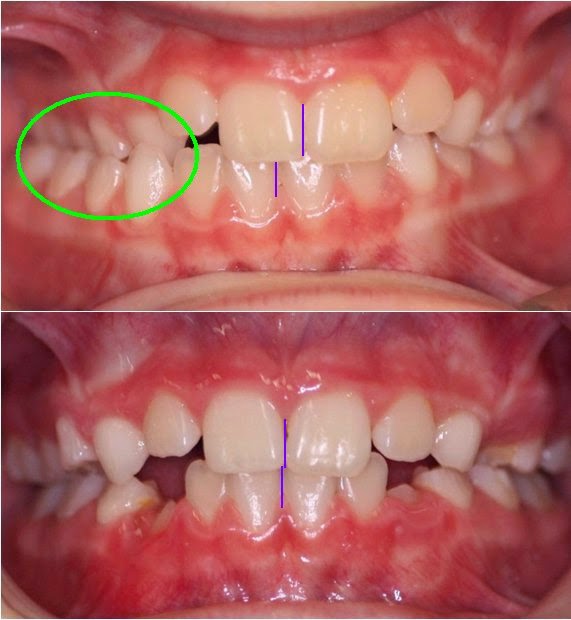
A posterior #crossbite (circled in green on the right) can result in a slide of the lower jaw to one side on closing creating a bite asymmetry and midline discrepancy (purple lines). Expansion to correct the bite interference can correct some asymmetries (as in this example) while others will have a persistent asymmetry that may require future treatment. Treatment of asymmetries will be the topic of a future Blog. Expansion can also be used to create space as covered in a previous Blog. So if you have a posterior crossbite, visit your orthodontist for them to assess the most appropriate appliance that best suits your needs.

Dr Peter Miles is the orthodontist at Newwave Orthodontics in Caloundra, Australia and teaches orthodontics part-time at the University of Queensland. He is a visiting lecturer at Seton Hill University in the USA as well as lectures internationally. Peter is one of the editors and authors of the orthodontic textbook, 'Evidence-Based Clinical Orthodontics'.

Sunday, 23 November 2014

MYOFUNCTIONAL APPLIANCES - WHAT'S THE EVIDENCE?

Myofunctional therapy is treatment aimed at changing muscle (Myo = muscle) function and possibly influencing jaw growth and the position of the teeth. Myofunctional appliances have been around in various forms for many years. These can include lip shields and screens, eruption guidance appliances and the T4K™.  Although claims are made that they alter muscle function resulting in improved facial growth, better alignment, and more stable results, what evidence is there to support these claims?

There are a number of studies examining the clinical effects of the eruption guidance appliance and the T4K™ and they provide clinical evidence as to the compliance and effect of these appliances.1-5 These appliances are available in a small range of sizes where one is selected to suit an individual rather than being custom made from an impression/scan. Possibly due to this generic fit, one study found 31% of patients did not wear the appliance.1 A randomised trial of the T4K™ vs. a custom made Activator appliance found the Activator caused less discomfort than the T4K™ and was more acceptable.6 All five studies showed that treatment at age 5-9 was quite long (13-36 months) and protrusion of the top teeth was reduced by only a small amount (1.5-2.5mm).1-5 A study of the T4K™ appliance showed it had no growth effect.3 Another study on the eruption guidance appliance followed patients over time and found the small 2mm improvement in crowding relapsed to the initial state which shows it is not stable.4 A 2mm improvement in bite depth was also unstable and relapsed leaving only 0.5mm of change.

A 2mm change is considered a minor improvement and could be treated once all adult teeth have erupted (~age 12-13) in one phase of treatment. This results in a reduced overall treatment time as well as potentially less cost than doing two or more phases of treatment. Clinical trials in the both the USA and the United Kingdom where patients were randomly assigned to early or late treatment have shown that when patients were treated early for much more severe protrusions (7mm rather than 2mm) they could be treated equally as well by delaying treatment until all the baby teeth had been lost.7,8 The result of treating later (~ age 12-13 years of age) was a shorter overall treatment and less cost. However a case can be made for early treatment to reduce protrusive teeth when the appearance or function is concerning the patient or for a small reduction in the risk of trauma to the front teeth (see my previous post on trauma).

So if you are unsure about whether early treatment is required for your child, consult your orthodontist. Some problems such as crossbites and impacted teeth can be detected and treated more effectively if found early. Your orthodontist is an expert in growth and development and can best determine if early treatment or simply monitoring your child is indicated to achieve the most efficient and cost-effective treatment at the most appropriate time.

References:
1. Keski-Nisula. American Journal of Orthodontics & Dentofacial Orthopedics 2008;133:254-60
2. Methenitou. Journal of Pedodontics 1990;14:219-30
3. Usumez. Angle Orthodontist 2004;74:605-60
4. Janson. American Journal of Orthodontics & Dentofacial Orthopedics 2007;131:717-28
5. Myrland et al. European Journal of Orthodontics 2015;37:128-134
6. Idris. European Journal of Paediatric Dentistry 2012;13:219-24
7. Tulloch. American Journal of Orthodontics & Dentofacial Orthopedics 2004;125:657-67
8. O’Brien. American Journal of Orthodontics & Dentofacial Orthopedics 2009;135:573-9

Dr Peter Miles is the orthodontist at Newwave Orthodontics in Caloundra, Australia and teaches orthodontics part-time at the University of Queensland and is a visiting lecturer at Seton Hill University in the USA. Peter is one of the editors and authors of the orthodontic textbook, 'Evidence-Based Clinical Orthodontics'. Importantly, he has no financial interest in any products discussed in these Blogs.